
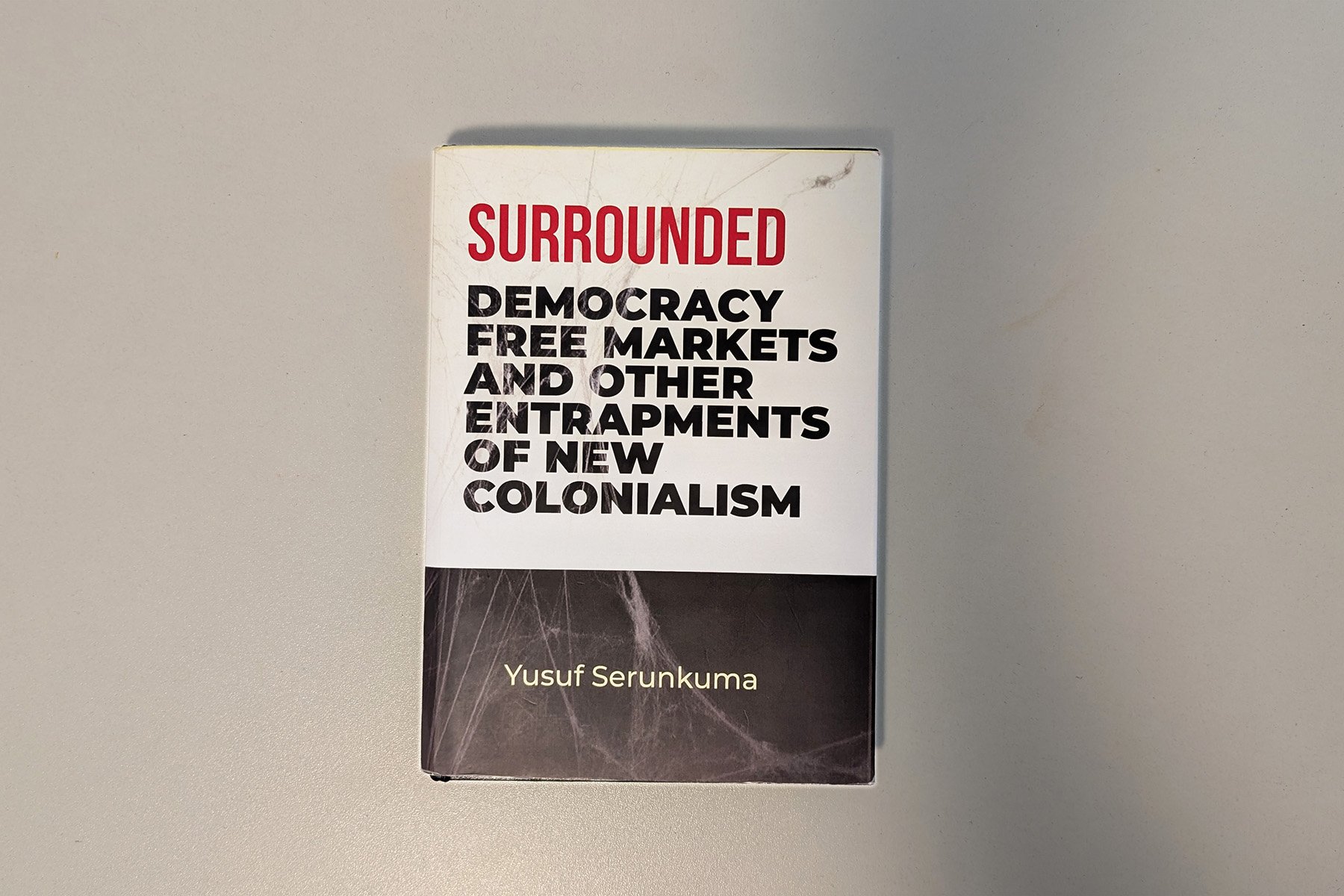
Dr. Yusuf Serunkuma’s new book “Surrounded: Democracy, Free Markets and Other Entrapments of New Colonialism” should trigger urgent reflections for land reform advocates in Africa.
In Uganda for example, where only 3 of 24 banks are locally owned, the push to register customary land—often justified by the promise of “access to credit”—may be quite flawed. Citing Bank of Uganda data, Dr Serunkuma in page 43 asserts that banks earn massive profits (over $215M in 2019), with 72% of profits leaving the country (to their foreign owners). He also notes that lending rates in Uganda and Africa at large range from 12–30%, among the highest globally. He thus argues that practically, banks don’t expect borrowers to succeed—they expect them to default. And this is where the catch is — so the banks can seize the collateral: mostly land.
Therefore, if we (governments, development partners, NGOs etc) are promoting customary land titling (including conversion to freehold land tenure 😭) in contexts like Uganda’s, without addressing other underlying issues like financial literacy, exploitative lending, and foreign capital dominance, we risk becoming (Yusuf asserts that we already are) agents of something akin to neocolonial land dispossession, not empowerment. This is because in a few years, armed with land titles, people – mostly rural-based, poor, and semi-illiterate – will be tempted to rush for credit facilities from banks to deal with their everyday challenges (like health, education etc), which they will most likely be unable to pay back. Next step: the banks, with all their publicly known fierceness, will come for the borrowers’ collateral. In other words, the banks are “most importantly”, as he argues, “looking at your collateral, which they will also take”.
Where does such a scenario leave our already vulnerable societies? What’s the plight of women and children likely to be caught in that mix? Where does it leave the future generations (on whose behalf customary land is also held)?
As stakeholders, we need to rethink the narrative. Land security (often mistakenly equated to land titles) must not become an ultimate enabler of dispossession. Unchecked, this will become the mother of all ironies 🙃