
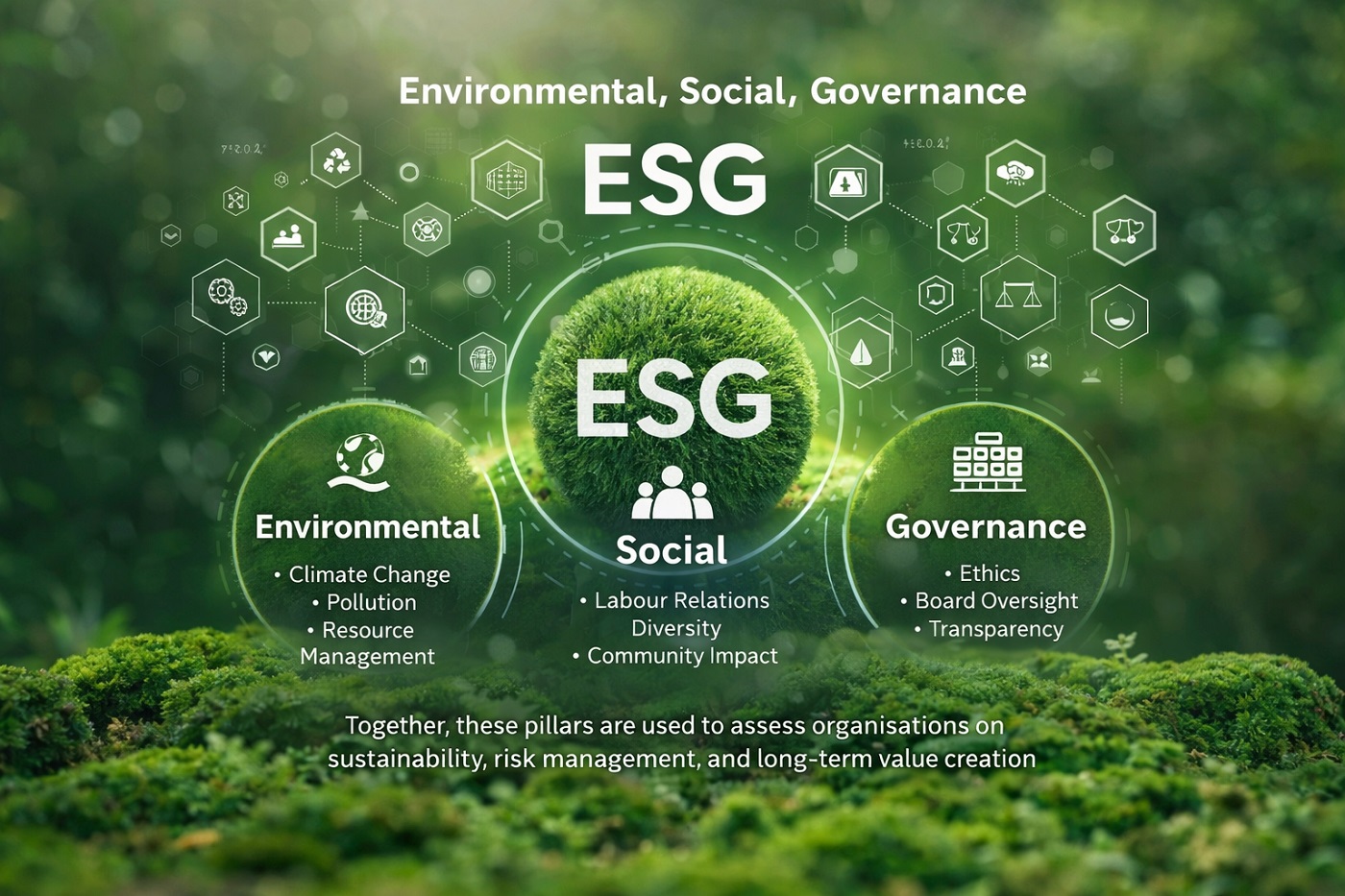
ESG, in full, refers to Environmental, Social, and Governance. Together, these three pillars are used to assess how organisations manage sustainability, risk, and long‑term value creation.
As discussed in our previous article, the evolution of ESG is closely linked to the growing prominence of stakeholder theory, a shift that challenged the idea that companies exist solely to maximise shareholder value.
ESG and Stakeholder Theory
Stakeholder theory recognises that companies affect and are affected by a wide range of actors, collectively referred to as stakeholders. These include investors, employees (often represented by unions), suppliers, customers, regulators, creditors, local communities and the general public.
From this perspective, boards are expected to balance competing stakeholder interests when making decisions, determining on a case‑by‑case basis which interests should take priority in a given context. Crucially, this approach places non‑financial considerations such as employee welfare, community impact, and environmental protection on equal footing with financial objectives like profitability and return on investment.
At its core, stakeholder theory requires organisations to act as responsible corporate citizens, consciously accounting for the social and environmental consequences of their decisions and operations.
The Triple Bottom Line: Profit, People, Planet
In 1994, John Elkington introduced the Triple Bottom Line as an accounting framework that expanded how organisational performance is measured. Rather than focusing exclusively on financial outcomes, the framework called for organisations to assess and disclose their social and environmental performance alongside profit and loss.
Elkington argued that only by accounting for profit, people, and planet could organisations fully understand the true cost of doing business. Importantly, measuring social and environmental impacts was seen not merely as a reporting exercise, but as a way to influence behaviour, encouraging boards and management teams to pay closer attention to these issues and embed them into decision‑making.
This thinking laid important groundwork for what we now recognise as ESG.
The Three Pillars of ESG
The environmental pillar considers how an organisation impacts the planet and how environmental factors, in turn, affect the organisation. This includes issues such as pollution, waste management, resource use, carbon emissions, water consumption, energy efficiency, and recycling.
Environmental
The environmental pillar considers how an organisation impacts the planet and how environmental factors, in turn, affect the organisation. This includes issues such as pollution, waste management, resource use, carbon emissions, water consumption, energy efficiency, and recycling.
Beyond measuring and reducing environmental harm, this pillar also encourages organisations to assess climate‑related risks and opportunities. Climate change can disrupt operations, supply chains, and markets, making environmental stewardship a strategic, not merely ethical consideration.
Social
The social pillar focuses on how an organisation relates to people. This includes employees, customers, shareholders, and the communities in which the organisation operates.
Key considerations include labour practices, workplace health and safety, diversity, equity and inclusion, human rights, customer protection, and community engagement. Increasingly, organisations are also expected to demonstrate how they contribute positively to social development, whether through fair employment, responsible sourcing, or meaningful community investment.
Governance
Governance addresses how an organisation is directed and controlled. It asks whether the organisation is governed transparently, ethically, and accountably and whether decision‑making structures promote long‑term sustainability.
This pillar covers board composition and effectiveness, executive accountability, risk management, data protection and cybersecurity, supply‑chain oversight, and the quality of corporate disclosures. Boards, as the highest governance organ in most organisations, carry ultimate responsibility for organisational health.
Effective governance requires boards to balance short‑term pressures with long‑term consequences, carefully managing tensions between immediate financial returns and sustainable value creation for shareholders and stakeholders alike.
ESG and Sustainability
Sustainability is often described as an organisation’s ability to meet present needs without compromising the ability of future generations to meet theirs. In practical terms, it is about long‑term organisational survival and resilience.
ESG provides a structured way to operationalise sustainability by embedding environmental, social, and governance considerations into strategy, operations, and oversight. This is why the two concepts are so closely linked: ESG offers the tools and metrics through which sustainability ambitions can be translated into action.
In this sense, ESG is not an abstract ideal. It is a practical framework for making better decisions in a world where economic performance, social responsibility, and environmental stewardship are increasingly inseparable.
ESGIntegration #NaturalResourceGovernance #CorporateGovernance #SustainabilityLeadership #DevelopmentFinance