
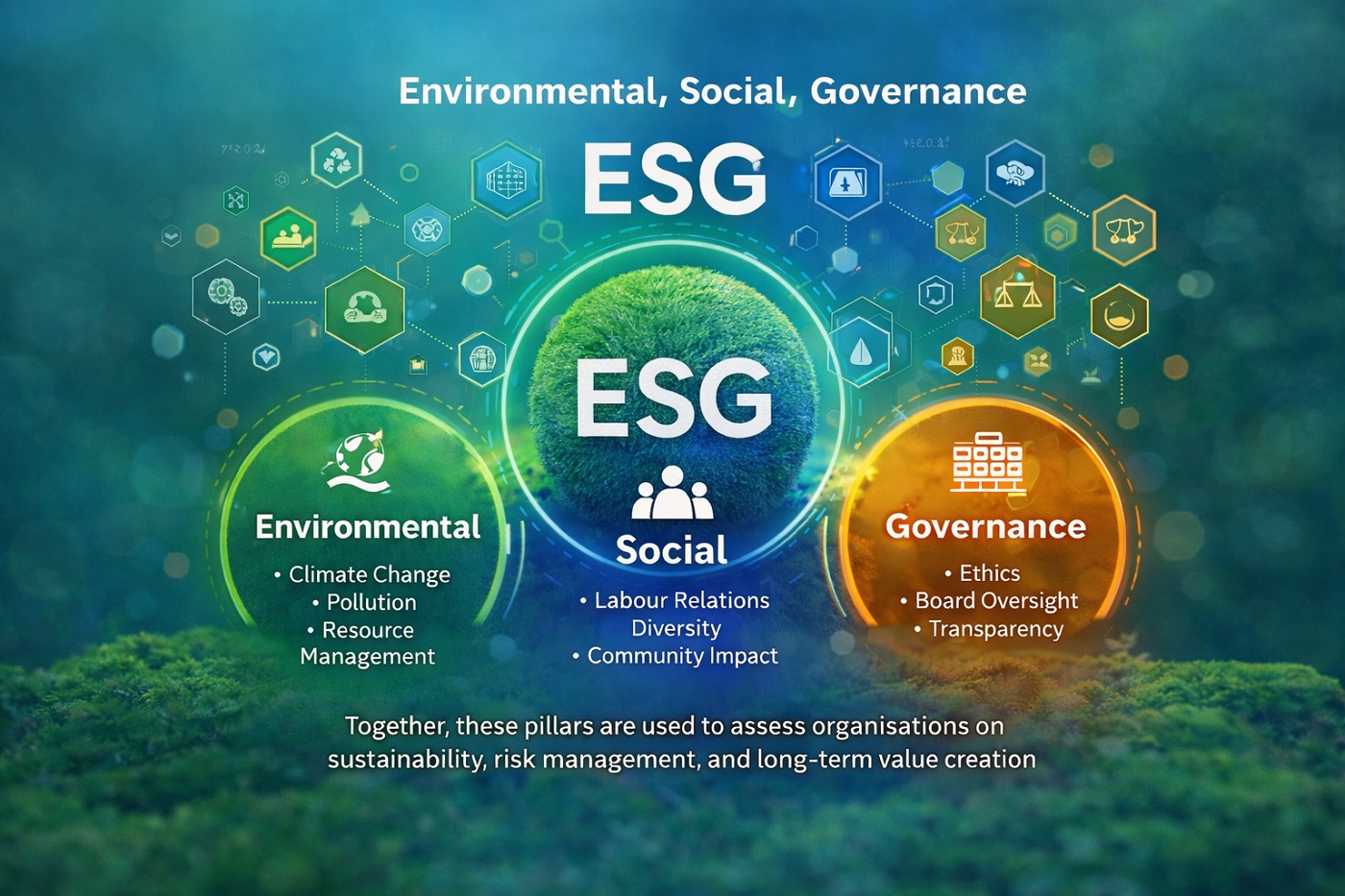
ESG did not emerge overnight. What we recognise today as Environmental, Social and Governance (ESG) principles is the result of a long evolution one that began centuries before the acronym existed. Religious groups such as the Quakers and Methodists avoided industries linked to harm, including slavery and exploitative labor. These early forms of ethical investing established a foundational principle: how profits are generated matters.
The 1950s–1960s: The Birth of Corporate Social Responsibility.
Much later, the modern concept of corporate social responsibility (CSR) emerged in the 1950s. Scholars such as Howard Bowen argued that businesses have obligations beyond profit maximization. CSR in this era was voluntary and values-driven, reflecting a growing recognition that corporations influence social outcomes.
By the 1960s, corporations with more questionable values were being cornered. Social movements including civil rights activism and environmental protests intensified public scrutiny of corporate behavior. Social responsibility shifted from moral preference to social expectation.
The 1970s–1980s: From Ethics to Strategy.
The 1970s marked a turning point. CSR became more structured as companies began responding proactively to social and environmental concerns. Environmental accountability gained prominence, influenced by increased regulation and public awareness of corporate environmental harm.
In the 1980s, CSR evolved further from philanthropy to strategy. Companies increasingly recognized that ethical conduct and financial performance could reinforce each other. Stakeholder theory gained traction, beyond creating value for shareholders, organisations were recognised as an integral part of an ecosystem to which they must contribute positively.
The 1990s: Accountability and Sustainability
Increased globalization in the 1990s brought new challenges. Multinational corporations faced growing scrutiny over labor practices and environmental degradation in developing countries. High-profile scandals such as that of the Nike sweatshops forced companies to take responsibility for their supply chains. Sustainability emerged as a central concept, reinforced by global milestones such as the 1992 Earth Summit.
The 2000s: The Emergence of ESG
The term ESG (Environmental, Social, and Governance) was coined and formally introduced in 2004. It first appeared in a landmark report titled “Who Cares Wins – Connecting Financial Markets to a Changing World”. The report was a joint initiative launched by the UN Secretary-General and the UN Global Compact.
ESG emerged to address the limitations of CSR, particularly, the lack of accountability and comparability. Investors increasingly demanded data on environmental impact, social performance and governance quality. They argued that it was not enough for companies to do good, they must also do well. Frameworks such as the Global Reporting Initiative (GRI) and the UN Principles for Responsible Investment (PRI) provided structure and comparability.
The 2010s: ESG Goes Mainstream.
Following the 2008 global financial crisis, Boards began to embed ESG considerations in investment decisions and core business strategy, further reinforced by the UN Sustainable Development Goals launched in 2015. ESG ratings and indices became widely used tools for assessing long-term risk and value.
The 2020s: From Compliance to Strategy.
Today, it goes further, embedding sustainability into core business models to drive innovation, resilience and competitive advantage. Sustainability is now viewed as a boardroom issue (governance), not a reporting exercise.
Modern ESG frameworks are more sophisticated, actively identifying companies that manage environmental risks, create positive social impact and are positioned for long-term success. Frameworks such as Global Reporting Initiative (GRI), Sustainability Accounting Standards Board (SASB) and the EU’s Corporate Sustainability Reporting Directive (CSRD) have moved ESG from narrative to evidence, improving transparency, comparability and accountability across markets.
The question has shifted to “Are you doing good across the entire supply chain while creating shareholder value?”
ESG in Africa: Opportunity, Not Imitation.
In Africa, ESG is not just a trend to be followed, it has the potential to be a game changing development tool. The continent’s natural resource wealth and renewable energy potential offer immense opportunity, yet historical extractive models have often left communities and ecosystems vulnerable.
Now with increased regulation, changing consumer demands, investor pressure and growing pools of ESG-linked capital, adopting this framework is becoming a strategic necessity, thereby making equitable development more attainable. In the African context, ESG is not simply about responsible investment, it is about shaping a more equitable, resilient and sustainable development path for the continent.